

How business leaders should think about ‘keeping up’ with the pace of technology
A “two-speed strategy” that could be a playbook to have the cake and eat it too.

One question I get repeatedly from business owners is “Technology is changing and advancing so quickly. How can I keep up or should I even try and keep up”.
Revenues may be steady. Margins may be intact, if thinner than they once were. The balance sheet may inspire no immediate alarm. And yet the conversation turns, almost ritualistically, to the rapid releases of AI capabilities and models and the media news cycles of impending doom and disruption. A competitor has announced an AI-enabled platform. A private-equity partner is asking about automation. A vendor promises dramatic productivity gains. Directors or the board or the business owners want reassurance that the firm is not falling behind or missing the boat.
The anxiety and the FOMO is understandable. The cadence of technological change has altered. What once arrived in discernible waves—enterprise software in the 1990s, the internet in the 2000s, mobile in the 2010s—now comes as a continuous tremor. New models are released weekly. Tools that seemed cutting-edge last quarter are now table stakes. The fear is not merely of obsolescence, but of strategic misjudgment: move too slowly and risk irrelevance; move too quickly and destabilise the enterprise.
The instinctive response is to accelerate. In my experience, that is precisely the wrong reflex. When business leaders force this ‘accelerate now’ on to their teams it becomes unwieldy and a reason for poor ROI and discontent with and within their teams. While technology companies can adapt fast because that IS their business, other businesses attempting to do the same is almost irresponsible. There is no surprise that most business leaders are weary of tech services companies promising the world and under delivering each time.
In periods of rapid innovation, advantage does not go to those who move fastest everywhere. It goes to those who decide carefully where speed is appropriate—and where it is reckless. The firms that endure technological acceleration design themselves to operate at two speeds.
The Illusion That Everything Is Changing
The first error many leaders make is assuming that because technology is changing rapidly, everything in their organisation must change with it.
This is rarely true. It is also daunting and almost irresponsible to think that businesses can keep up only if the ‘IT team’ comes along.
In every industry I encounter—manufacturing, distribution, healthcare, financial services—there are structural constants. Financial reporting must be accurate and auditable. Customer and product data must be trustworthy. Regulatory obligations must be met. Cash flow must be managed with discipline. Core operational workflows—order to cash, procure to pay, record to report—remain recognisable decade after decade.
These are not trends. They are economic foundations.
And yet firms routinely treat them as malleable. They layer automation on top of fragmented enterprise systems. They deploy predictive analytics on top of inconsistent data definitions. They try to embed artificial intelligence within processes that have never been standardized.
The result is not transformation but entanglement. Technology accelerates inconsistency rather than eliminating it.
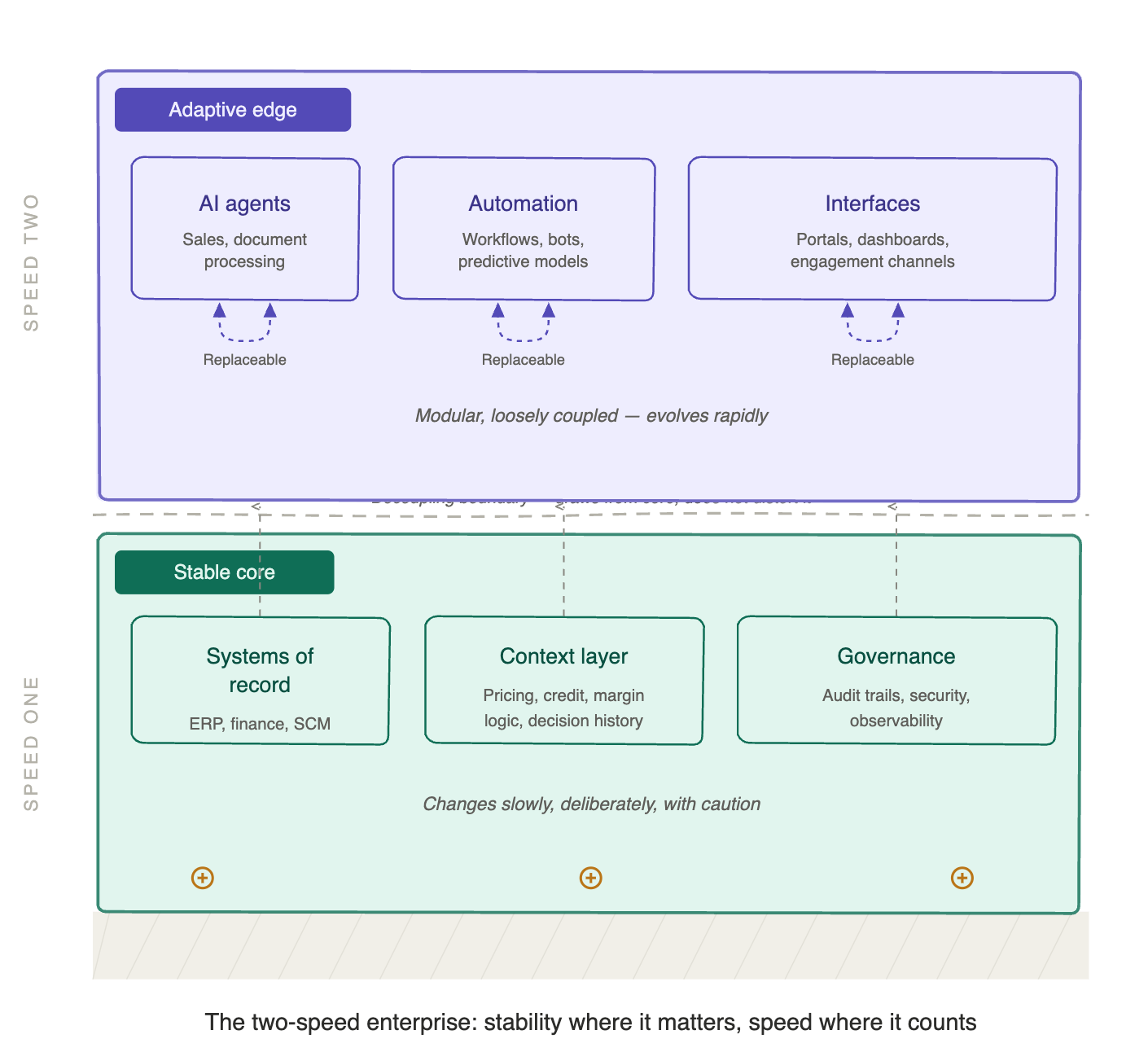
The more durable approach is to separate the architecture of the firm into two categories: what must endure, and what will inevitably evolve.
Speed One: The Stable Core
The first speed governs the structural core of the business. It moves slowly, deliberately and with caution.
At its base lie the systems of record: enterprise resource planning, financial systems, supply-chain platforms, customer and product master data. These systems hold the canonical truth of the organisation. The data model that underpins them should not mutate with every pilot. The chart of accounts should not be rewritten to accommodate a new dashboard. The SKU hierarchy should not bend to suit a temporary tool.
Re-platforming this layer is disruptive and expensive. It affects reporting integrity, compliance, auditability and valuation. It must be modernised over time, but not in reaction to each technological tremor.
Above the raw systems of record sits what might be called the context layer: the structured interpretation of data that reflects how the business thinks. Pricing rules. Credit policies. Approval thresholds. Margin logic. Forecasting assumptions. Decision histories. This is institutional knowledge made explicit.
When this layer is governed and version-controlled, it becomes a strategic asset. It enables consistent decisions at scale. When it is unstable or embedded haphazardly in tools at the edge, the organisation loses coherence.
Observability, too, belongs firmly in the stable core. Monitoring, audit trails, security logging and decision traceability are not experimental luxuries; they are risk controls. In an era of automated decisions, the ability to explain how a result was generated is as important as the result itself.
This entire stable core—the systems of record, the context layer and the governance mechanisms that surround them—constitutes Speed One. It should change, but slowly. It is the spine of the enterprise.
Speed Two: The Adaptive Edge
The second speed governs what will change repeatedly, sometimes unpredictably.
User interfaces evolve as customer expectations shift. Artificial-intelligence engines improve and commoditise. Automation frameworks rise and fall. Collaboration tools proliferate and consolidate. Channels of engagement multiply.
These layers are inherently volatile. Treating them as permanent fixtures is a category error.
Artificial-intelligence agents that assist sales teams, automation bots that process documents, predictive models that forecast demand—these belong at the adaptive edge. So do customer portals, workflow engines and operational dashboards. They should be modular, loosely coupled and replaceable.
If a superior AI model becomes available next year, adopting it should not require rewriting the enterprise system. If a new engagement channel emerges, integrating it should not compromise financial integrity.
The discipline lies in decoupling. The adaptive edge must sit on top of the stable core, drawing from it but not distorting it.
I wrote about how I think technology strategy is business strategy expressed in systems. This article will be a good read to further ground this thinking.
Architecture as Strategy
This separation—between stable core and adaptive edge—is not an IT preference. It is strategic positioning.
Consider two firms of similar size in the same sector. Both face identical technological waves. One responds energetically to each development, embedding new tools deeply within legacy processes, layering integrations hastily, rewriting core logic to accommodate each innovation. The other modernizes its systems of record, clarifies its decision logic and enforces data governance. It then experiments at the edge, piloting AI agents and redesigning engagement layers without entangling them in the financial spine.
Five years later, the difference is stark. The first firm has accumulated technical debt and organisational fatigue. Each upgrade triggers a chain reaction. The second has accumulated optionality. Its core remains stable. Its edge can evolve. It can test and replace technologies without systemic shock.
Investors increasingly recognise this distinction. Valuation is no longer a function solely of earnings but of scalability and technological resilience. A tightly coupled architecture—opaque, brittle and dependent on specific vendors—carries hidden risk. A decoupled architecture signals adaptability. In uncertain markets, adaptability commands a premium.
Anchoring Decisions to Economics
Even with sound architecture, judgment remains essential.
When confronted with technological novelty, I resist framing the question as, “Do we have an AI strategy?” The more useful question is, “Where are we constrained?”
Is revenue limited by slow quoting cycles?
Are margins leaking through inconsistent procurement?
Is growth capped by manual onboarding?
Are decisions too slow because data is fragmented?
Only when a constraint is clearly identified does technology merit consideration. Every initiative should map to a tangible economic outcome: revenue acceleration, margin expansion or scalability.
This filter eliminates much of the noise. It also protects the organisation from innovation theatre—projects launched to signal modernity rather than deliver results.
Governance in a Two-Speed World
Operating at two speeds does not mean neglecting experimentation. It means containing it.
The stable core must be protected. The majority of capital and attention should strengthen data quality, integration discipline, security and compliance. A defined, controlled portion can fund exploration at the edge—pilots that are measurable, time-bound and reversible.
Success should be judged by operating metrics, not the number of initiatives launched. Closing a pilot that fails to deliver is evidence of governance, not defeat.
The Role of Artificial Intelligence
Artificial intelligence, for all its promise, belongs firmly in Speed Two.
Models will improve. Providers will consolidate. Capabilities will commoditise. Embedding any specific model deeply into the core of the enterprise is a wager on permanence that history does not support.
The enduring asset is not the algorithm. It is the clean data, structured context and governed decision logic upon which algorithms operate.
Firms that understand this distinction will adopt AI pragmatically and replace it ruthlessly when superior options emerge. Those that do not may find themselves rebuilding foundations to accommodate tools that were transient all along.
Judgment Over Velocity
Technology will continue to accelerate. The question for mid-market leaders is not whether to move fast. It is where to move fast—and where to resist the temptation.
Speed at the edge enables experimentation, learning and competitive differentiation. Stability at the core preserves coherence, integrity and economic control.
In an era that equates speed with progress, the more difficult virtue is discrimination. Not every layer deserves reinvention. Not every wave deserves pursuit. The firms that endure will be those that master both velocities simultaneously—moving quickly where change is inevitable, and deliberately where permanence still matters.
TL;DR
Technology is accelerating, but not every part of your business should move at the same speed.
Separate your architecture into two layers:
Speed One (Stable Core): systems of record, data models, decision logic and governance. These change slowly and deliberately.
Speed Two (Adaptive Edge): AI agents, automation tools, user interfaces and engagement layers. These are modular and replaceable.
Decouple the edge from the core so innovation does not destabilise financial integrity or operational coherence.
Anchor all technology decisions to economic constraints—revenue, margin and scalability.
Protect the core. Experiment at the edge. Replace tools freely, but guard your foundations carefully.
In a fast changing technology landscape, advantage lies not in moving fastest everywhere, but in knowing precisely where speed belongs.